
Every stage of textile processing demands precise chemical control. From fiber preparation to final finishing, the right formulations determine color consistency, fabric handle, and end-use performance.
Seeds Energy supplies application-matched chemicals across the full processing cycle. Each product is selected for fiber compatibility and process stability, not offered as a general-purpose solution.
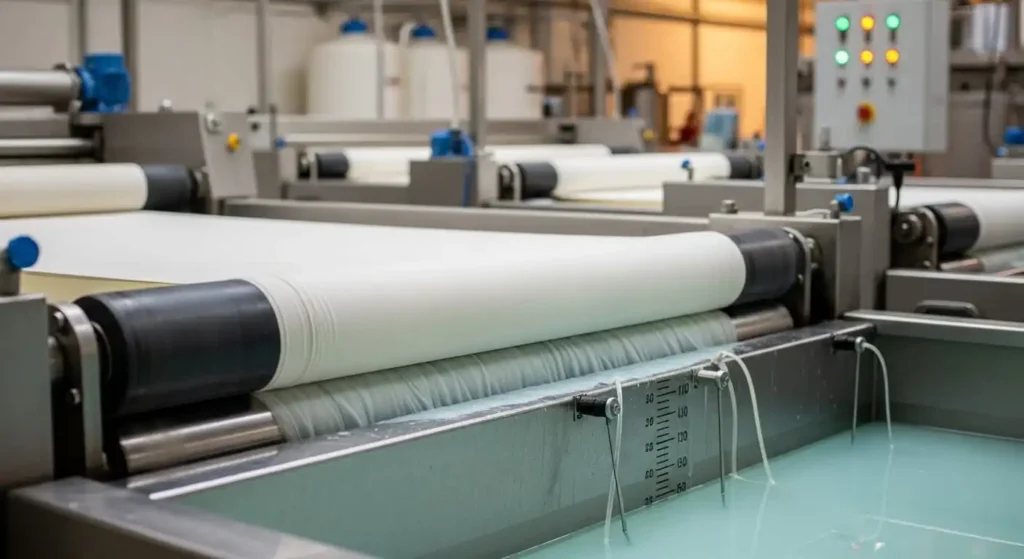
Remove size materials, natural impurities, and surface contaminants from greige fabric to create a clean, absorbent base for dyeing and finishing.
Remove starch, PVA, and synthetic binders applied during weaving to restore absorbency for downstream processing.
Strip natural waxes, oils, and dirt from fibers to improve wettability and ensure consistent dyeing performance.
Reduce surface tension for deeper chemical penetration during scouring, bleaching, and dyeing operations.
Hydrogen peroxide-based systems that remove natural coloration, delivering a clean white base for uniform dyeing.
Bind calcium and iron ions to prevent interference, staining, and uneven dye uptake during processing.
Ensure uniform dye uptake across fabric, preventing patchiness and shade variation in batch and continuous dyeing.
Improve dye fixation onto fibers for better wash fastness, reduced bleeding, and longer color durability.
Maintain even dye distribution in the bath, preventing agglomeration and improving color penetration and stability.
Ensure even dye penetration, consistent shade development, and strong color fixation across batch and continuous dyeing processes.
Improve fabric handle, appearance, and functional performance through softening, brightening, and protective finish applications.
Reflect blue light to enhance fabric whiteness and deliver a brighter, more appealing finished appearance.
Improve hand feel, smoothness, and flexibility across fabrics. Available in hydrophilic and hydrophobic variants.
Advanced softening systems delivering superior softness, lubrication, and drape for high-quality finishing applications.
Add water resistance, oil repellency, anti-static behavior, and wrinkle resistance to technical and specialty textiles.
Prevent bacterial growth on textiles, improving hygiene and odor control in medical and performance fabrics.
Add performance properties to fabric including water resistance, oil repellency, anti-static behavior, and wrinkle resistance for technical and specialty textile applications.
Control viscosity, adhesion, and dye fixation for sharp, durable print results across screen, digital, and rotary printing processes.
Improve adhesion, durability, and mechanical strength in coating, printing, and finishing applications.
Control viscosity in printing pastes and coating systems for sharp definition and consistent application.
Improve dye fixation, penetration, and print clarity across textile printing processes.
Biochemical solutions for desizing, bio-polishing, and peroxide removal that enhance fabric quality with lower environmental impact.
Maintain clean, consistent processing conditions by preventing dye redeposition, controlling bath stability, and ensuring reliable results across production runs.
Eco-friendly biochemical treatments that replace harsh chemicals in desizing, bio-polishing, and peroxide removal without compromising fabric quality.
Biochemical solutions used for eco-friendly processing such as desizing, bio-polishing, and peroxide removal. Enhance fabric quality while reducing environmental impact.
Textile processing demands chemicals that perform reliably across varying fiber types, temperatures, and process conditions.
Seeds Energy textile chemicals cover the full production cycle, from fiber preparation and dyeing to finishing and printing.
Each formulation targets specific process outcomes — whether that is color consistency, fabric softness, or print definition — without compromising downstream steps or fabric integrity.
Uniform dye uptake and fixation across batch and continuous processes.
Preserves fiber integrity throughout pre-treatment, dyeing, and finishing stages.
Reduces rework, chemical waste, and production downtime at every stage.
Delivers softness, repellency, and functional finishes tailored to end-use requirements.
Controls viscosity and adhesion for sharp, durable print results.
Enzymatic and low-impact formulations available for sustainable textile production.

Textile production leaves little room for inconsistency.
Seeds Energy supplies application-matched chemicals across every processing stage, selected for fiber compatibility and process stability.
Each product targets a specific outcome rather than serving as a general-purpose solution.
For mills where shade variation, fabric defects, or process inefficiencies carry direct commercial consequences, that precision is what matters.
Proven Quality
High-standard formulations, every batch.
Full-Spectrum Coverage
Every processing stage, one source.
Application-Specific
Matched to fiber type and process conditions.
Process Efficiency
Less rework, consistent production output.
Dependable Supply
Reliable logistics, uninterrupted production schedules.
Maximize well performance with our advanced production enhancement chemicals. Contact our experts for tailored recommendations and technical advice to select the right solutions for your wells.
Discover the products that deliver safe, efficient, and reliable results for every stage of your oilfield operations.
Desizing agents, scouring agents, wetting agents, bleaching agents, and sequestering agents — each targeting specific impurities to prepare fabric for uniform dyeing.
Impurities left on fiber cause uneven dye uptake, shade variation, and patchiness. No dyeing program corrects a poorly prepared fabric base.
Inconsistent chemical concentrations, temperature fluctuations, incorrect leveling agent dosage, or shifts in water quality.
They bond dye molecules to fiber, reducing mobility during washing. Without fixation, reactive and direct dyes bleed significantly.
Silicone softeners deliver smoothness and durability. Non-silicone variants suit applications requiring hydrophilicity, such as toweling and moisture-wicking fabrics.
When targeting reduced effluent, lower energy use, or compliance with ZDHC or Oeko-Tex standards. Most effective in desizing and bio-polishing cotton fabrics.
They absorb UV light and re-emit it as visible blue light, optically compensating for the yellowish tone in natural fibers.
Against REACH, Oeko-Tex Standard 100, and ZDHC MRSL through restricted substance testing before production use.
Not always. Silicone emulsions, repellents, and antimicrobial finishes behave differently on cotton, polyester, nylon, and blends.
Incorrect thickener viscosity, insufficient binder concentration, or improper curing temperature during application.